
Diagnostic testing plays a vital role in understanding your pets health.
Early detection allows us to identify concerns sooner, improve treatment outcomes, and establish baseline information for future care.
As a pet parent, you may notice when something “isn’t quite right” with your pet, but determining the cause is not always straightforward. That is where diagnostic testing comes in. At Mission Vet Urgent Care - Blue Ash, our veterinary team is committed to providing a complete picture of your pets health through advanced laboratory and diagnostic services, helping us make informed decisions and deliver the best possible care.
Emergency Tests & Diagnostics
During your pet’s stay, we provide the highest-quality care and attention.
Our vet team is skilled in offering diagnostic and medical care and work with compassion and efficiency to ensure a positive outcome.
We offer the latest diagnostics and testing for our urgent care patients at our emergency veterinary clinic, including:
In-House Laboratory
At our Mission Vet Urgent Care hospitals, we offer various blood screens, pre-anesthetic bloodwork, and other diagnostic tests, with results available same-day in most cases. Specifically, our on-site laboratory can test the following:
- Liver Enzyme Screening: This test looks for high levels of enzymes in the blood resulting from cell damage. High levels of enzymes can be a concern, but it does not always indicate disease.
- Renal (Kidney) Profiles: Checking your pet’s kidneys through a series of blood tests can identify signs of kidney disease and diabetes risk.
- Complete Blood Counts (CBC): A CBC is a full panel blood test that evaluates your pet’s overall health and provides information about their hydration status, anemia, infection, blood clotting ability and immune system response.
- General Chemistries: A general chemistry test will measure the levels of certain chemical components in the blood. These include electrolytes, fats, glucose, proteins and enzymes.
- Feline Leukemia (FeLV) and Feline Immunodeficiency Virus (FIV): If you own a cat, consider FeLV and FIV testing. Two blood tests are taken to diagnose FeLV and FIV, including the enzyme-linked immunosorbent assay (ELISA) and the immunofluorescent antibody (IFA) tests.
- Parvovirus: Canine parvovirus (CPV) is contagious between dogs. If your dog is showing symptoms, a blood test can determine the presence of the parvovirus B19 antibody.
- Urinalysis: This test looks at your pet’s urine to evaluate their hydration status and detect any abnormalities such as protein, blood or sugar. If any are found, further tests may need to be run for diabetes, urinary tract infections or kidney stones.
- Clotting Times: A blood sample is drawn from your pet and checked for clot formation in a pre-warmed tube. The doctor will note the time it takes for your pet’s blood to clot.
- If your pet requires any testing beyond our scope, we are happy to send bloodwork or another test to an outside lab. They will send the results back to us at their earliest convenience.
Digital Radiology
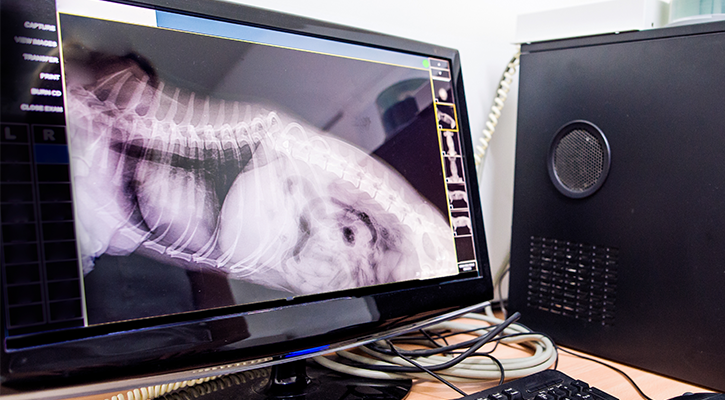
In addition to our in-house laboratory services, we offer digital radiology — or pet Xrays. We have advanced pet imaging tests to provide the best results and diagnostics for our patients.
An X-ray directs electromagnetic radiation toward the body to see internal structures. We use it to detect any issues your pet may be struggling with, including soft tissue damage, skeletal fractures or foreign bodies.Every radiograph is backed by specialist support. In addition to our doctors' evaluation, we partner with board-certified veterinary radiologists who provide expert interpretation of your pet's images, giving us an additional layer of diagnostic confidence when making recommendations for your pet's care.
Limited Scope Ultrasound
Limited scope ultrasounds play a vital role in providing immediate diagnostic services for pets in need of assessment and treatment. Our hospitals are equipped with portable ultrasound machines, enabling our veterinarians to conduct quick evaluations of specific areas such as the abdomen, chest, or musculoskeletal system. By visualizing internal structures, limited scope ultrasound helps identify potential injuries, diseases, or abnormalities, allowing for prompt decision-making and appropriate treatment strategies. Although it may not offer the same level of detail as specialized ultrasound, limited scope ultrasound provides valuable real-time diagnostic information, expediting the diagnostic process and facilitating timely interventions in urgent care scenarios.

Cookies on this website are used to both support the function and performance of the site, and also for marketing purposes, including personalizing content and tailoring advertising to your interests. To manage marketing cookies on this website, please select the button that indicates your preferences. More information can be found in our privacy policy here.